Formulaires — legacy configuration guide
Customer administrator — legacy
Access and initial setup
Open Performance → Questionnaires using a role with questionnaire access. The Interview playbook describes Create → 1 to 1 → Select for interview questionnaires. Creating/copying a questionnaire changes stored data; open an existing form for inspection instead of creating a disposable draft on production.
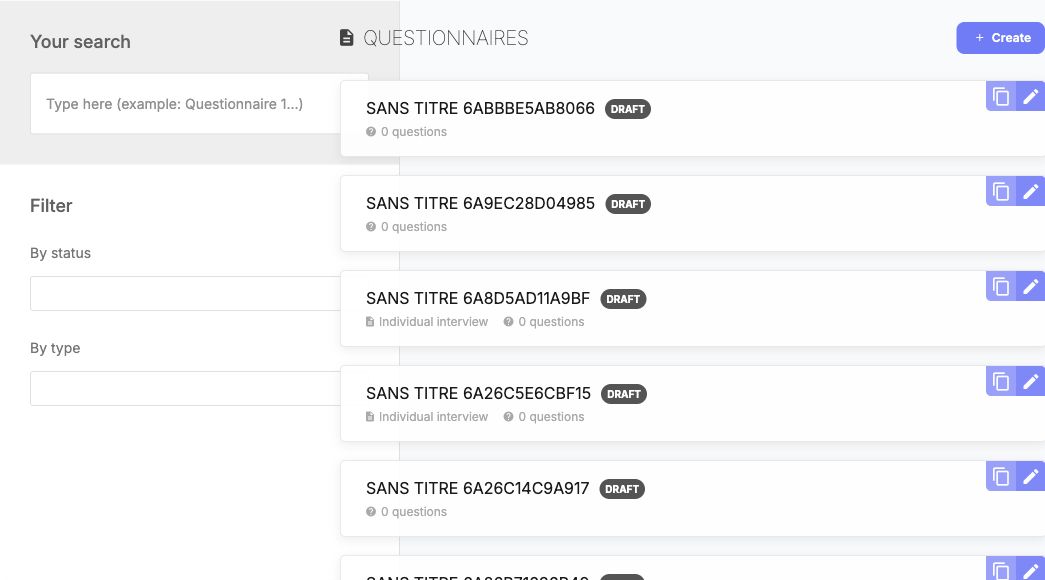
Use the title, status and type criteria to locate the intended questionnaire. Copying creates a separate stored questionnaire; it is not a preview.
Structure, questions and access
| Setting | Values / dependency | Administrator task and effect |
|---|---|---|
| Form information / status | Title, content and available legacy statuses. Library exposes Draft, Published and Archive. | Use a clear versioned title and finish content before selecting it in a campaign. Status changes are persistent. |
| Section / message | Section headings and explanatory content. | Organize the journey; these are not answer-bearing questions themselves. |
| Simple / open text | Short/single-line and multiline legacy families. | Choose according to the expected response. The old playbook's text-limit advice is documentary guidance, not a verified universal validation rule. |
| Select / choice | Configured options and single/multiple-answer behavior. | Define meaningful labels and permitted answer counts. “Not filled” is a documented optional select choice, not automatically a valid required answer. |
| Rating | Scale and display. | Review bounds and labels. The 2023 playbook recommends a scale up to 6; it does not establish current nextgen or universal server limits. |
| Objectives | Previous/future evaluation questions and applicable periods. | Prepare periods before campaign setup. The answers can reference goal records rather than a scalar field. |
| Skills / specialized questions | Available according to type and activation. | Verify skills, target levels and relevant profile/referential data. Do not assume People Review-specific matrix/succession questions belong in a 1-to-1. |
| Employee / manager access | Documentary examples distinguish no access, reading and reading/writing. | Configure and test each persona separately. Do not infer that both can edit every question. |
| Languages | Authored questionnaire translations. | Translate question titles, instructions and options. Changing UI language does not translate authored content. |
The legacy table question is documented but discouraged by the playbook; its actual availability also depends on activation. Preserve existing answered forms until their dependencies have been reviewed. Use a separate approved version for future campaigns rather than assuming edits safely update past answers.
Customer administrator — nextgen / redesign
1. Locate or create a form
Open Performance → Forms [new]. Search by name/creator, filter Draft/Published and Read only, and inspect existing content before creating a new version.

Use the name, creator, publication and read-only filters to locate a form. Read only filters campaign usage; it does not change editing permissions. Search criteria do not modify forms. See functional for each filter.
The checked UI requires create-form for creation. API routes distinguish read, create, update and delete permissions. Access to the menu alone is insufficient evidence of every action right.
2. Build sections and questions
Start with a title and optional description, then add one or more sections. Give each section a clear heading and, when useful, a short instruction. Use the form overview to review the order before saving. Choose the content language deliberately: it is separate from the interface language. Optional generation can propose content from a sufficiently detailed title; review every generated question and option before keeping it.
| Question option | Verified choices / behavior | Effect and validation |
|---|---|---|
| Family | Text, numeric, single answer, multiple answers, scale, list, skills, past objectives, future objectives, development, date in the checked builder schema. | Select a family matching the expected answer. Frontend names map to backend question types; they are not interchangeable legacy type codes. |
| Title / description | Localized content; title and instructions can vary by locale. | Translate the meaning as well as choice labels. |
| Required | Boolean; checked frontend schema defaults to false. | Required-answer validation applies when completing the participant's preparation. This frontend default is not proof of all server defaults. |
| Visibility | Employee, evaluators or all. | Selects the question audience; it does not alone determine when another participant sees answers. |
| Evaluator-specific wording | Optional customization when audience is all. | Backend requires evaluator titles when customization is enabled for all; rejects supplied evaluator wording outside the allowed configuration. |
| Choice options / counts | Form-defined choices and applicable minimum/maximum selection settings. | Keep labels and allowed counts coherent. Empty choice sets or inconsistent limits need correction before use. |
| Scale / numeric / date | Type-specific bounds, labels and display settings. | Do not use a legacy rating limit as the nextgen limit. Date questions can have minimum/maximum dates. |
| List / skills / objectives / development | Referentials, skill selection, periods and specialist options. | Verify the underlying data and participant rights. A development question can depend on the training catalog. |
| Position / sections | Ordered section/question structure. | Check participant navigation and the preview/overview after reordering. |
Generation produces a proposal; review every question, choice, audience and translation before saving or publishing.
3. Save, translate, publish and assign
Save the form before adding content languages. For each language, translate the form title and description, section headings and instructions, question titles and descriptions, evaluator-specific wording and every choice label. Preview each language and correct missing or inconsistent content. Save the finished form, then use its status menu to publish it when it is ready for use. Publication makes the form available for selection; it does not assign employees or start a campaign. Select the published form separately when configuring the nextgen interview campaign.
For example, a bilingual form can combine a required text question with an optional single-choice question. The preview helps authors review the structure and locale, but only completing the assigned campaign shows the respondent workflow and required-answer validation.
4. Manage read-only forms and new versions
Verified in code: FormRepository::formHasActiveCampaign treats use by in-progress, done or archived campaigns as active for the read-only calculation. Draft and not-started campaigns do not count. Thus “read only” and “published” express different conditions.
When changes are needed, inspect existing usage and duplicate into a new version where appropriate. Do not promise that all modifications are permitted simply because a list filter says editable. The backend also validates conditional section structure and specialist answer compatibility. In particular, the development-question opinion scale cannot shrink below the highest already-used opinion. Unpublishing does not establish an undo of prior answers, campaign references or read-only state.
Save and reopen a legacy draft
An authorized manager can prepare a reusable form without publishing it or assigning employees.
- Open Performance → Questionnaires → Créer.
- Choose an available form family. Support entretien was used for this example.
- In the settings tab, enter Nom du questionnaire and the optional description. Keep Statut du questionnaire → Brouillon, then choose Enregistrer.
- In the Questions tab, choose Ajouter une question → Question ouverte. Enter the question title, select Champ obligatoire when intended, then choose Nouveau.
- Reopen the questionnaire. Check its saved title, description, type and draft status.
- In the Questions tab, open the question’s … → Éditer menu. Check that the title and required checkbox remain; use Annuler to leave inspection without changing the question.
Application example: an unpublished legacy draft retained its title, description and Support entretien type after reopening. Its open question retained the required setting. It was not assigned to a campaign. The legacy Tests type could not be confirmed as saved.
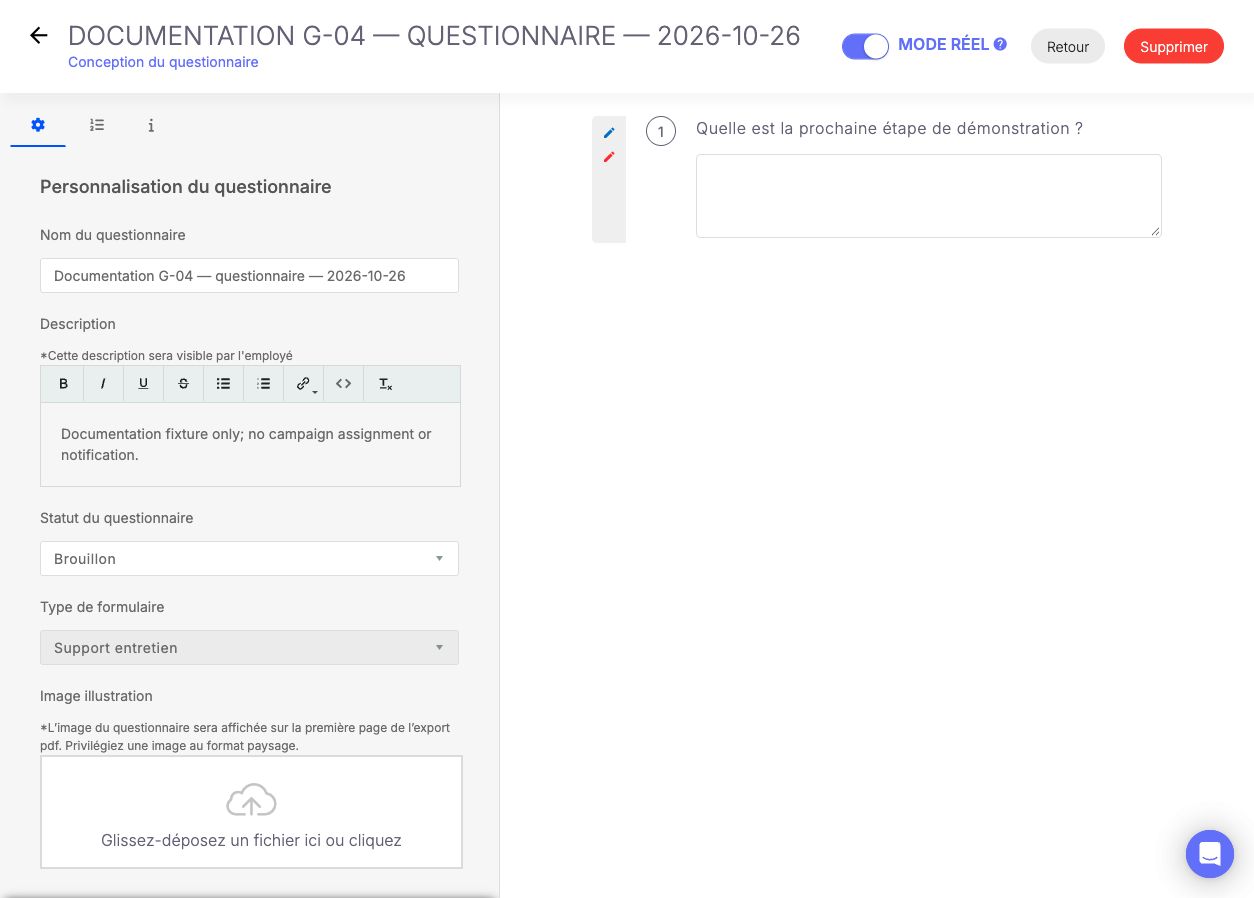
The reopened draft retains its name, description, Brouillon status and Support entretien type. The question preview is form content, not a submitted employee answer.
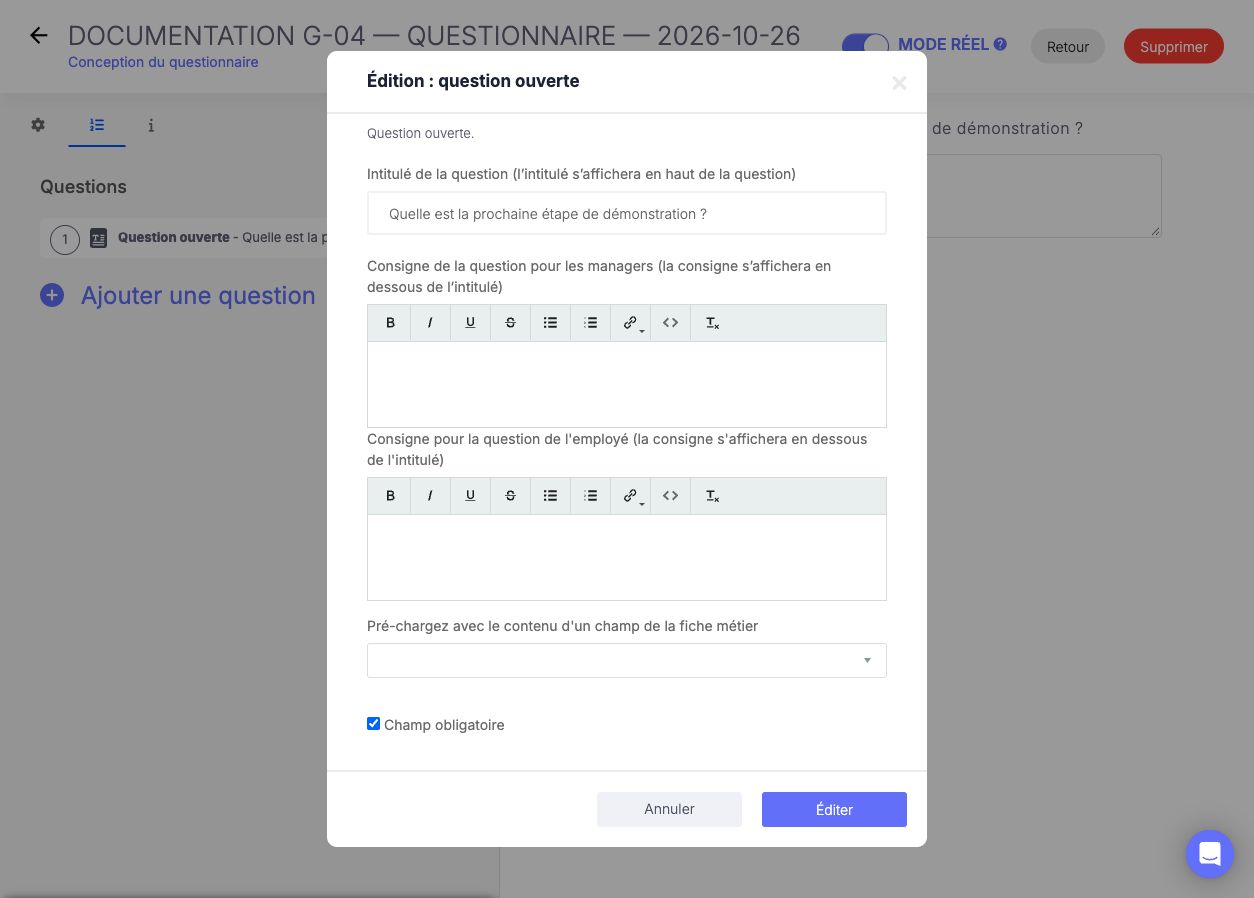
The reopened question editor retains its title and the checked Champ obligatoire option. This verifies question configuration; respondent-side validation still requires an assigned campaign.
Dernière mise à jour : 3 novembre 2026