User management — redesign functional guide
Before you begin
Open the company workspace with an account that has permission to manage employees. Depending on your workspace, the Employees menu can offer:
| Entry | Opens |
|---|---|
| List of Employees | Legacy employee table with column filters. |
| Employees [new] | Redesigned user list, sometimes embedded in the company workspace. |
| Add Employee | Legacy employee-creation form. |
The legacy table and redesigned list have different filters and create flows. Use the labels and controls on the screen you opened.
A user account is the person's login identity and status. Its employee profile holds work information. The manager relationship identifies a reporting line; a reference job is separate from a free-text employee position. Roles and visibility groups control access and data scope; see Roles and permissions.
Find a user in the redesigned list
- Open Employees [new].
- Search by name, select one or more managers, and choose Active or Inactive if needed. The list updates as you change the filters.
- Sort the available columns or move between pages.
- Open an authorized employee row to view its details.

Use name, manager and status filters to narrow the list. These filters help locate a user; they do not change employee details.
| Control | How it works |
|---|---|
| Search | Enter all or part of a name. Clear the text to broaden the results. |
| Manager | Select one or more managers to show their reports. Remove a selection to broaden the results. |
| Status filter | Choose Status for no status restriction, or choose Active or Inactive. This filters the list; it does not change account status. |
| Column headings | Select a sortable heading to change the displayed order. |
| Pagination | Use the page controls to move through matching results. After changing filters, check the current page if the list appears empty. |
| Reset search | When available in an empty result, clears the name, manager and status filters. |
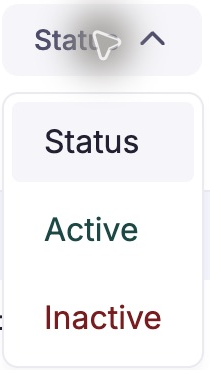
The list filter offers Status, Active and Inactive. Selecting one narrows the list; it does not activate or deactivate an account.
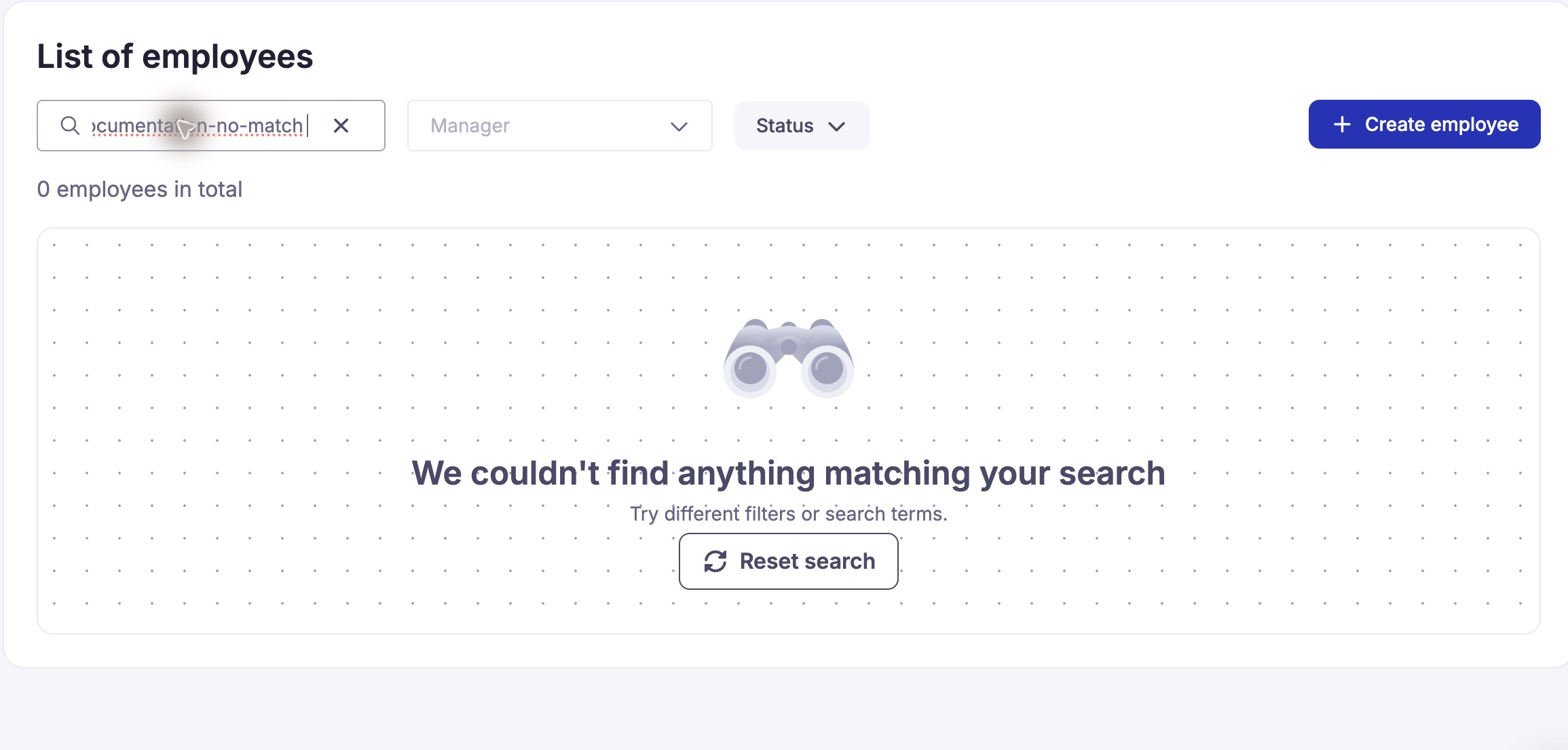
When no user matches, clear or reset the filters to broaden the list. Filtering does not remove an account.
Create or update a user in the redesigned form
The redesigned form uses Basic Information and Additional Information steps. The fields marked in the form are required.
- Choose Create employee from the redesigned user area, or open an existing employee to edit it.
- In Basic Information, enter the first name, last name and email, select the account status, and choose the employee's job and manager.
- Choose Next. Complete any required fields highlighted by the form before continuing.
- In Additional Information, add the available country, city, address or birth-date details when relevant.
- Review the information and use the form's create or update action.
- Return to the list and reopen the record to confirm its identity, manager and job.
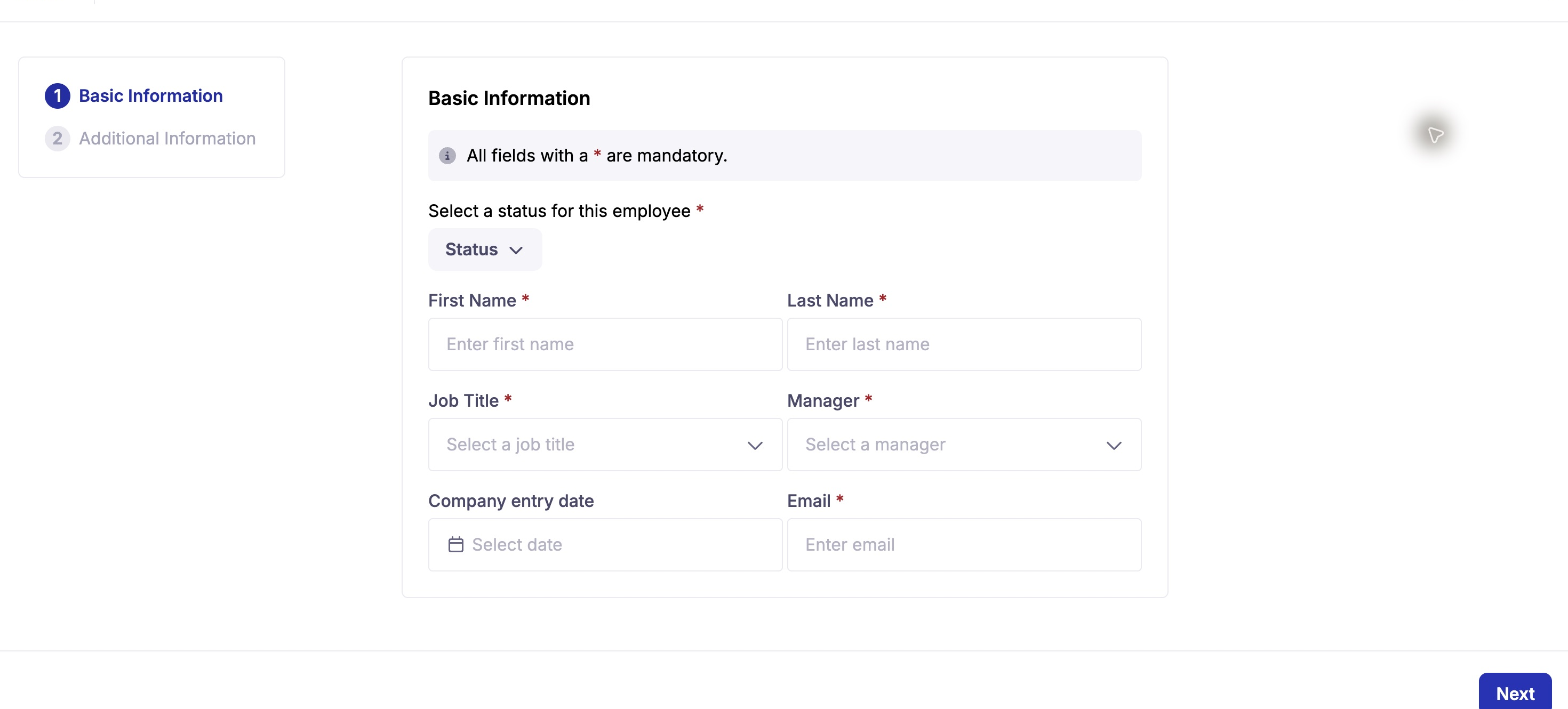
Basic Information is the first step. Complete the required identity, status, job and manager fields before continuing.
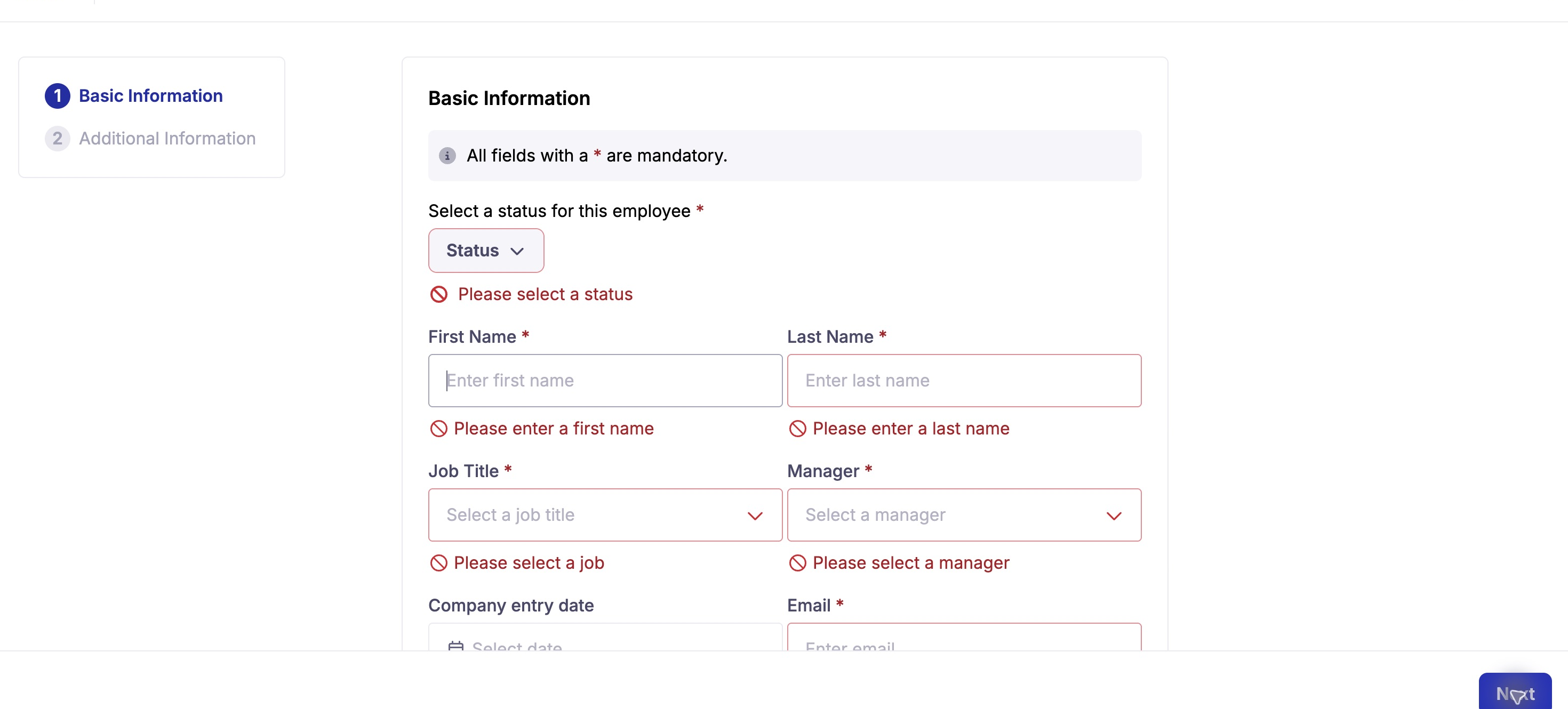
If required information is missing, the form highlights the fields that need attention. Complete them before moving to the next step.
Status and role permissions are separate. Selecting Inactive controls the account state; it does not remove roles or visibility groups. A reference Job in this form is different from the free-text Collaborator’s post field in the legacy form.
Change an account's active status
- Find and open the employee record in Employees [new].
- Choose the edit action and update Status in Basic Information.
- Save the form and reopen the record to confirm the displayed status.
Use Inactive when the account should no longer be active. This status change does not delete the employee record, remove assigned roles or change the employee's manager and job. If the account should be active again, select Active and save. For a role or visibility change, use Roles and permissions.
View your own profile
Employees use Personal space → Profile for their own information and assigned activities. User creation, account status, employee populations and role administration require separate company-administration access.

The personal navigation provides employee features. Account administration is available only through an authorized company workspace.
Troubleshooting
| Situation | What to do |
|---|---|
| A menu or employee record is unavailable | Ask an administrator to check your workspace, permissions and employee visibility. |
| A search returns no users | Clear or reset the filters and check the current page. |
| The email address is already in use | Open the existing record before creating another account. |
| The employee appears without the selected job | Ask an administrator to check the record before retrying; job assignment and user creation can be separate. |
| Login details cannot be sent | Check whether the company has enabled the Send login details employee option. |
| An account is inactive | Account activation is separate from erasing the employee record and from role assignment. |
Dernière mise à jour : 3 novembre 2026